
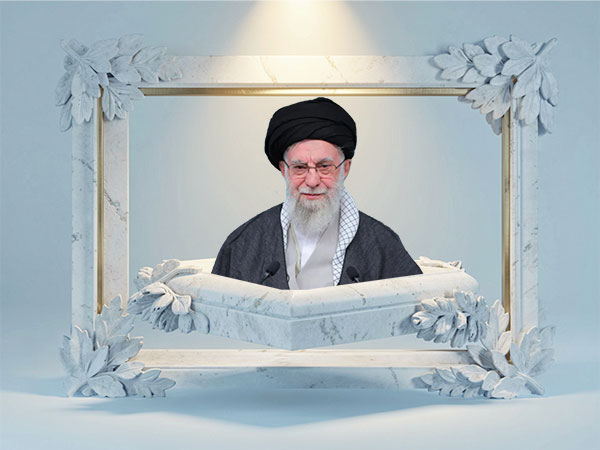

In the early hours of March 1, 2026, Iranian state television broadcast an announcement that sent shockwaves across the Muslim world and beyond. With a presenter struggling to maintain composure on live television, the Islamic Republic of Iran confirmed what many had feared since the previous day's devastating US-Israeli airstrikes on Tehran: Ayatollah Sayyid Ali Hosseini Khamenei, the Supreme Leader of Iran for nearly four decades, had attained martyrdom while performing his duties at his office.
For Muslim Mirror's inaugural list of the 100 most influential Muslims in the world, Ayatollah Khamenei is posthumously named Man of the Year 2026 — not merely because of the dramatic circumstances of his death, but because his 37-year leadership shaped the geopolitical, theological, and military landscape of West Asia in ways few Muslim leaders have ever done. His martyrdom has triggered a regional war, reshaped alliances, and left an indelible mark on Shia Islam and the broader Muslim ummah.
This profile is a factual account of his life, leadership, and legacy as confirmed by Iranian state media, international news agencies, and official statements from world capitals.
The Martyrdom That Changed the World
On the morning of February 28, 2026, the United States and Israel launched what has been described as the most extensive coordinated military operation against Iran in decades. Long-range missiles struck a leadership compound in central Tehran at approximately 9:40 AM local time. According to reports citing CIA intelligence published by The New York Times, American intelligence agencies had been tracking Khamenei's movements for months and learned that a meeting of top Iranian officials was scheduled that morning.
The strike killed not only the Supreme Leader but also several senior Iranian officials, including:
-- Mohammad Pakpour, Commander of the Islamic Revolutionary Guard Corps (IRGC) Ground Forces
-- Ali Shamkhani, a top security adviser to Khamenei
-- Four members of Khamenei's family — his daughter, son-in-law, daughter-in-law, and a grandchild
Israeli Prime Minister Benjamin Netanyahu confirmed the operation, stating: "This morning, we destroyed the compound of the tyrant Khamenei. There are many signs that this tyrant is no longer". US President Donald Trump announced on his Truth Social platform: "Khamenei, one of the most evil people in History, is dead. This is not only Justice for the people of Iran, but for all Great Americans".
Iran's Confirmation and Response
Initially, confusion reigned. Iranian news agencies Tasnim and Mehr briefly rejected reports of Khamenei's death, with a source close to his office claiming he was "steadfast and firmly commanding the field". However, by the early hours of March 1, Iranian state broadcaster Press TV and the official Islamic Republic News Agency (IRNA) confirmed the news.
The Iranian cabinet issued a statement declaring 40 days of national mourning and a one-week public holiday. The statement described the attack as a "brutal attack by the criminal U.S. government and the sinister Israeli regime" and praised Khamenei for having led the country "sagaciously" for more than 37 years.
The Islamic Revolutionary Guard Corps vowed "a hard, decisive, and regret-inducing" punishment on the "murderers". Within hours, Iran launched a large-scale missile and drone barrage toward Israel under an operation named "Fateh Khyber," while also striking US assets in the Gulf region, including near Abu Dhabi.
The Succession
In accordance with Article 111 of Iran's Constitution, a temporary governing council was formed comprising President Masoud Pezeshkian, judiciary head Gholamhossein Mohseni-Ejei, and Khamenei adviser Mohammad Mokhber. However, within weeks, Mojtaba Khamenei, the late leader's son, was appointed as the new Supreme Leader.
The Man Behind the Turban: Early Life and Rise to Power
Ayatollah Ali Khamenei was born on April 19, 1939, in Mashhad, Iran's holiest Shia city, into a modest religious family. He studied under prominent clerics, including Ayatollah Ruhollah Khomeini, during his seminary years in Qom and Najaf. Unlike the scholarly and reclusive Khomeini, Khamenei was a political animal from the start, arrested and exiled several times by the Shah's regime in the 1960s and 1970s.
The 1979 Islamic Revolution catapulted him to prominence. He served as deputy minister of defense, Tehran's Friday prayer leader, and later as President of Iran from 1981 to 1989 — a period that included the brutal Iran-Iraq War. During that war, an assassination attempt by the Mujahideen-e-Khalq (MEK) in 1981 permanently paralyzed his right arm, an injury he carried for the remaining 45 years of his life.
When Khomeini died in 1989, the Assembly of Experts controversially elected Khamenei as Supreme Leader despite his relatively low clerical rank at the time (he was later promoted to Grand Ayatollah). Western analysts predicted he would not survive long. He proved them wrong for 37 years.
The Supreme Leader's Powers
As Vali-e Faqih (Supreme Jurisprudent), Khamenei's powers were vast and constitutionally embedded. He controlled the armed forces (including the elite IRGC), state-run media, judiciary, and the key foundations (bonyads) that owned large swaths of the Iranian economy. He appointed the heads of the judiciary and state broadcasting, confirmed the president after election, and had final say on all matters of state, especially foreign policy and nuclear affairs.
He was a leader with "near-dictatorial powers". Yet to his millions of followers across the Shia world — from the alleys of south Beirut to the streets of Karachi and Lucknow — he was the Guardian Jurist, the living embodiment of resistance against Western arrogance.
The Architect of the Axis of Resistance
Perhaps no single Muslim leader in the modern era has shaped West Asian geopolitics as profoundly as Khamenei. Through what scholars call the "Axis of Resistance," he projected Iranian power across the region:
Lebanon
He was the ultimate patron of Hezbollah, which he considered the most successful export of the Iranian revolution. Hezbollah's massive arsenal and political dominance in Lebanon existed largely with his blessing and funding. Secretary-General Hassan Nasrallah repeatedly referred to Khamenei as his spiritual guide.
Syria and Iraq
Iranian militias, including the Fatemiyoun (Afghan) and Zainabiyoun (Pakistani) brigades, operated under his strategic direction. In Iraq, Khamenei commanded loyalty from major Shia political factions and militias like Kata'ib Hezbollah. The Popular Mobilization Forces (PMF), integrated into the Iraqi state, owed their existence to his vision.
Yemen
His support for the Houthi movement (Ansar Allah) transformed a local Zaydi Shia revivalist group into a regional power capable of targeting Saudi oil facilities and Red Sea shipping — disrupting global trade for months on end.
Palestine
Khamenei made opposition to Israel the central plank of his foreign policy, calling Israel a "cancerous tumor" that must be removed. He provided funding, rockets, and training to Hamas and Palestinian Islamic Jihad, positioning Iran as the most formidable state backer of Palestinian armed resistance.
For millions of Shia Muslims in South Asia — particularly in Lucknow, Karachi, and Mumbai — Khamenei remained a spiritual reference (marja). His religious rulings on matters of prayer, fasting, and personal status were followed by a substantial minority within India's own Shia community, estimated at 15-20% of India's 200 million Muslims.
Part IV: The Leader and His Contradictions
Inside Iran, Khamenei was a deeply polarizing figure. To his loyalists — the Hezbollahi (Partisans of God), the Basij militiamen, and the rural poor who received state subsidies — he was the guardian of Islam against Western decadence. To millions of urban, educated Iranians who risked their lives in the 2009 Green Movement, the 2019 fuel protests, and the 2022-2023 "Woman, Life, Freedom" uprising, he was a distant, security-obsessed autocrat presiding over economic collapse and social repression.
The 2022 protests, sparked by the death of Mahsa Amini in morality police custody, represented the most widespread challenge to his authority in decades. His response was brutal: over 500 protesters killed, thousands arrested, and several executions. The regime survived, but the legitimacy deficit remained.
Culturally, Khamenei was a man of apparent asceticism. He lived in a modest compound in Tehran's Niavaran district, wrote poetry (some of which has been published), and maintained a personal website answering religious questions. He was also an avid reader of political theory and history, known to annotate books heavily. Yet he presided over a system where dissent was met with imprisonment, torture, and execution.
India and the Muslim World React
For Muslim Mirror and its Indian readership, Khamenei's relationship with New Delhi was complex. India had historically maintained careful diplomatic ties with Tehran, balancing its need for Iranian oil and access to Chabahar port against its strategic partnership with Israel and the United States.
Following his martyrdom, the Iranian representative in India, Abdul Majid Hakim Elahi, expressed gratitude towards Indians who joined mourning processions in Lucknow, calling India a land of "loyalty and humanity". He stated: "He (Ayatollah Ali Khamenei) was the voice of those who had no voice of their own. He was the voice of conscience. These people have come here of their own free will. No one compelled them. This signifies that the land of India is a land of loyalty, humanity, and morality".
Across the Muslim world, reactions were divided along sectarian and political lines. Hezbollah and the Houthis declared days of mourning. Sunni Gulf states, long wary of Iranian expansionism, issued carefully worded statements expressing concern over regional escalation. Turkey's President Erdogan condemned the "assassination of a sitting leader" as a violation of international law. Pakistan's government announced a day of mourning, reflecting the deep affection for Khamenei among the country's sizeable Shia minority.
Russian President Vladimir Putin issued a strong condemnation, calling the assassination a "flagrant violation of international law" — a statement you referenced earlier.
The Legacy
Khamenei's greatest victory, in his own view, was survival. He saw the "Arab Spring" topple secular dictators (Mubarak, Ben Ali, Gaddafi) while his own system held. He saw the ISIS caliphate rise and fall without breaching Iran's borders. He weathered crippling US "maximum pressure" sanctions, the assassination of Qassem Soleimani (his most trusted general, by a US drone in 2020), and the sabotage of Iranian nuclear facilities allegedly by Israel.
His greatest failure was perhaps the growing secularism and cynicism of Iran's youth. But in death, as in life, he has proven to be a unifying figure for the resistance camp. As Iranian state television announced at his martyrdom: "With the martyrdom of the supreme leader, his path and mission neither will be lost nor will be forgotten [but] will be pursued with greater vigor and zeal".
The war triggered by his assassination continues to unfold. The new Supreme Leader, Mojtaba Khamenei, has called for a "comprehensive nationwide drive to restore infrastructure" and condemned the "vile and ruthless American and Zionist enemy". US President Trump has warned that Iran could face "severe military action in the coming weeks".
Why Ayatollah Ali Khamenei is Muslim Mirror's Man of the Year 2026
At Muslim Mirror, the "Man of the Year" designation in our list of the 100 most influential Muslims is not an award for virtue, piety, or moral excellence. It is a journalistic recognition of impact — the capacity of an individual to alter the course of events affecting the global Muslim ummah. By that measure, Ayatollah Ali Khamenei stands alone in 2026.
Here are the specific reasons for this choice.
1. He Defined an Era of Shia Power Projection
For 37 years, Khamenei was the supreme decision-maker of the Islamic Republic of Iran — the only Shia-majority power with significant regional reach. Under his leadership, Iran transformed from a isolated revolutionary state into a network of allied militias and political parties spanning Lebanon, Syria, Iraq, Yemen, and Palestine.
No other Muslim leader in the modern era has successfully built and maintained such an extensive transnational military architecture. Whether one supports or opposes the "Axis of Resistance," its existence is a testament to Khamenei's strategic patience and ideological consistency. He outlasted every US president from George H.W. Bush to Donald Trump (second term), every Israeli prime minister from Yitzhak Shamir to Benjamin Netanyahu (return), and every Saudi king from Fahd to Salman.
2. His Martyrdom Triggered a Regional War
A "Man of the Year" is often someone who changes the world in a single year. Khamenei's assassination on February 28, 2026, did exactly that.
Within hours of his confirmed martyrdom on March 1, 2026:
-- Iran launched "Operation Fateh Khyber," a massive missile and drone barrage toward Israel.
-- US military assets in the Gulf, including near Abu Dhabi, were struck.
-- Oil prices surged past $180 per barrel, the highest since the 1970s.
-- The UN Security Council held emergency sessions that failed to reach consensus.
-- World leaders from Moscow to Beijing condemned the extrajudicial killing of a sitting head of state.
The war triggered by his death is ongoing as of this writing (April 2026). Tens of thousands of lives have been lost. Global shipping through the Strait of Hormuz has been disrupted. The conflict has drawn in multiple nations, including the United States, Israel, Iran, Yemen's Houthis, Lebanon's Hezbollah, and various Iraqi militias.
No other Muslim in 2026 has had such a direct, violent, and immediate impact on global affairs — and that impact flows directly from the circumstances of his martyrdom.
3. He Was a Unifying Symbol for Resistance Movements
While Khamenei was divisive inside Iran, his standing among Shia communities worldwide — and among many non-Shia Muslims who oppose Western intervention in the Muslim world — was unparalleled. For millions, he represented the last major Muslim leader who openly defied US and Israeli hegemony without apology.
His death transformed him into a martyr. Mourning processions were held not only in Tehran, Qom, and Mashhad, but also in:
-- Lucknow, India – where thousands of Shia Muslims took to the streets
-- Karachi, Pakistan – where the government declared a day of mourning
-- Beirut, Lebanon – where Hezbollah organized mass gatherings
-- Sana'a, Yemen – where Houthi leaders praised him as a "lion of the ummah"
-- Baghdad, Iraq – where militias flew black flags of mourning
In death, Khamenei achieved a level of symbolic unity that eluded him in life. His name is now invoked alongside other iconic martyrs of resistance: Qassem Soleimani, Imad Mughniyeh, and Hussein ibn Ali himself.
4. He Forced a Succession That Will Shape the Next Decade
A leader's influence is often measured by what happens after they leave. Khamenei's death did not create a power vacuum — it triggered a swift, pre-planned succession. His son, Mojtaba Khamenei, was appointed Supreme Leader within weeks.
This hereditary succession — unprecedented in the Islamic Republic's history — has profound implications:
-- It consolidates power within the Khamenei family, creating a de facto dynasty.
-- It signals that the Velayat-e Faqih (Guardianship of the Jurist) has evolved into a system where lineage matters alongside clerical credentials.
-- It sets the stage for a potential confrontation between those who accept Mojtaba and those who believe the Supreme Leader should be elected by the Assembly of Experts without dynastic influence.
Whether Mojtaba succeeds or fails, the transition was engineered entirely by Ali Khamenei during his lifetime. His careful placement of loyalists, his grooming of his son (who held significant behind-the-scenes power for years), and his constitutional amendments ensured continuity. That is the mark of a leader who planned for his own death.
5. He Was a Target of Two Major Powers
Influence can be measured by who considers you an enemy. For decades, the United States and Israel devoted immense intelligence, military, and diplomatic resources to containing, weakening, and ultimately eliminating Khamenei.
This hereditary succession — unprecedented in the Islamic Republic's history — has profound implications:
-- The US designated the IRGC a Foreign Terrorist Organization.
-- Israel allegedly sabotaged Iranian nuclear facilities, assassinated nuclear scientists, and conducted covert operations inside Iran.
-- Both nations imposed crippling sanctions that damaged Iran's economy.
On February 28, 2026, they achieved their objective — but at a cost they may not have fully anticipated. The joint US-Israeli strike that killed Khamenei was described by Iran as an act of war. The retaliation is still unfolding. A "Man of the Year" who was targeted by the world's two most powerful military forces, and whose death has ignited a regional conflagration, cannot be ignored.
6. He Represented a Pole of the Muslim World's Division
The global Muslim ummah is not monolithic. It is divided by sect (Sunni vs. Shia), by politics (pro-Western vs. resistance), and by theology (traditional vs. revolutionary). Khamenei stood at the head of one major pole — the revolutionary Shia camp that sees armed resistance against Israel and the US as a religious duty.
His critics — including many Sunni leaders, Gulf monarchies, and Western-aligned Muslim governments — viewed him as a destabilizing sectarian figure who used Shia militias to expand Iranian influence. His supporters saw him as the last bulwark against complete Western domination of the Muslim world.
To be the most influential Muslim of the year, one does not need unanimous approval. One needs to be unavoidable. Khamenei was unavoidable. Every major news outlet in the world led with his death. Every world capital recalibrated its Middle East policy. Every Muslim, whether they loved him or hated him, had to confront the consequences of his martyrdom.
7. His Death Reshaped International Law Discourse
The assassination of a sitting head of state by foreign powers — without a UN mandate or declaration of war — is a flagrant violation of international law. World leaders including Russia's Vladimir Putin, China's Foreign Ministry, and Turkey's President Erdogan condemned the strike as illegal.
This has reopened debates about:
-- The prohibition on targeted killings of political leaders under the UN Charter.
-- The immunity of heads of state under customary international law.
-- The legitimacy of "preemptive self-defense" arguments used by the US and Israel.
Even nations that opposed Khamenei's policies expressed concern about the precedent set. If the US and Israel can assassinate the Supreme Leader of Iran without consequences, which Muslim leader is next? This question now haunts capitals from Riyadh to Islamabad.
8. He Was a Religious Authority for Tens of Millions
Beyond politics, Khamenei was a marja' al-taqlid (source of emulation) for Shia Muslims worldwide. His religious rulings (fatwas) covered everything from daily prayers to financial transactions to medical ethics. He issued a famous fatwa against nuclear weapons, declaring them haram (forbidden) under Islamic law — a position that Iran used diplomatically for years.
Even in death, his religious authority persists. His written works, recorded sermons, and legal opinions continue to guide millions of followers who have not yet transferred their allegiance to a new marja'. That is a form of influence that transcends mortality.
9. The Timing: 2026 as a Pivotal Year
Muslim Mirror launched its first "100 Most Influential Muslims" list in 2026. This year will be remembered as the year West Asia plunged into a major war triggered by the assassination of a Muslim leader. No other event in 2026 has had such profound implications for the ummah.
Khamenei's death has:
-- United Shia militias across multiple countries under a common banner of revenge.
-- Strained US-Israel relations, as some in Washington question whether the strike was wise.
-- Strengthened Iran-Russia-China alignment, as all three condemn Western overreach.
-- Increased the price of energy, affecting Muslim-majority economies from Indonesia to Nigeria.
-- Revived the Palestinian cause as a central issue, with Iran framing its retaliation as solidarity with Gaza.
A "Man of the Year" is someone who defines the year. In 2026, that person is Ayatollah Ali Khamenei — not because he sought the title, but because his martyrdom has reshaped the world his followers and enemies must now navigate.
A Note to Our Readers
Muslim Mirror understands that many of our readers — Sunni and Shia, pro-resistance and pro-dialogue, Indian and international — will have strong feelings about this choice. Some will celebrate Khamenei as a martyr of the ummah. Others will condemn him as a sectarian autocrat. We respect both views.Our selection is not a fatwa. It is not an endorsement of every action Khamenei took during his 37-year rule. It is a journalistic acknowledgment that no single Muslim in 2026 has had a greater impact on the lives, deaths, and futures of the global Muslim community than Ayatollah Ali Khamenei.
May Allah have mercy on all the dead — and guide the living toward justice.
— The Muslim Mirror Editorial Board, April 2026
— The Muslim Mirror editorial team acknowledges the diversity of opinion on Ayatollah Khamenei within the global Muslim community. This profile is a journalistic assessment of his life, power, and legacy following his confirmed martyrdom on March 1, 2026. May Allah grant him Jannat-ul-Firdaus.