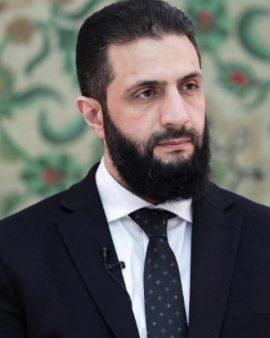
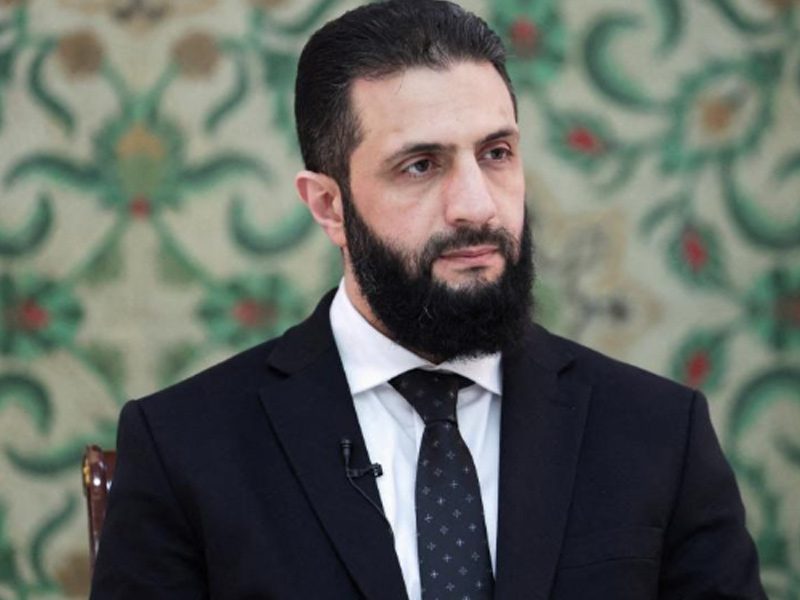

Ahmed Hussein al-Sharaa
Ahmed Hussein al-Sharaa (born 29 October 1982), also known by his nom de guerre Abu Mohammad al-Julani, is a Syrian politician, revolutionary figure, and former rebel commander who has served as President of Syria since 2025. Prior to assuming the presidency, he was the emir of Hay’at Tahrir al-Sham (HTS) from 2017 to 2025 and emerged as Syria’s de facto leader following the collapse of the Bashar al-Assad government in December 2024.
Al-Sharaa was born in Riyadh, Saudi Arabia, to a Syrian Sunni Muslim family with roots in Daraa and the Golan Heights, and was raised in Damascus. His early political radicalisation coincided with regional upheavals following the US invasion of Iraq. Shortly before the 2003 invasion, he joined al-Qaeda in Iraq and participated in the Iraqi insurgency for nearly three years. In 2006, he was captured by American forces and remained imprisoned until 2011. His release coincided with the outbreak of the Syrian uprising against the Ba‘athist government of Bashar al-Assad.
In 2012, al-Sharaa founded the al-Nusra Front with backing from al-Qaeda, positioning it as a leading armed faction seeking to overthrow the Assad regime. Under his leadership, the group consolidated control over parts of northwestern Syria, particularly the Idlib Governorate. Al-Sharaa gained prominence for resisting efforts by Abu Bakr al-Baghdadi to forcibly merge al-Nusra with the Islamic State, a dispute that led to prolonged armed clashes between the rival groups.
In 2016, al-Sharaa publicly severed ties with al-Qaeda, dismantled its loyalist networks, and rebranded his political posture. He renounced transnational jihadism, shifted focus to Syrian national governance, and pledged protection for religious and ethnic minorities—moves widely interpreted as an attempt to gain broader domestic acceptance and international legitimacy.
In 2017, al-Sharaa merged al-Nusra with allied factions to form Hay’at Tahrir al-Sham, serving as its emir until 2025. HTS established the Syrian Salvation Government (SSG), a technocratic civil administration in Idlib that collected taxes, provided public services, and issued identity documents. Despite maintaining relative stability, the SSG faced internal protests and criticism for authoritarian practices and suppression of dissent.
In November 2024, al-Sharaa launched an 11-day military offensive that rapidly captured Aleppo, Hama, Homs, and Damascus, precipitating the flight of Bashar al-Assad to Russia and the collapse of the Ba‘athist state. Al-Sharaa headed a caretaker government from 8 December 2024 and was formally appointed President of Syria on 29 January 2025 at the Syrian Revolution Victory Conference held in the People’s Palace.
As president, al-Sharaa has prioritised state reconstruction, consolidation of authority, military integration, and the restoration of diplomatic relations with regional and global powers, including the United States and Russia. Domestically, his agenda has focused on economic recovery, refugee repatriation, security stabilisation, and minority reconciliation. He signed an agreement with the Syrian Democratic Forces to integrate their military and civil institutions into the state, though implementation remains unresolved.
His first year in office was marked by sectarian violence, including massacres targeting Alawites and clashes in southern Syria involving government-affiliated forces, drawing domestic and international criticism. Following Israel’s intensified military actions from the occupied Golan Heights, al-Sharaa reaffirmed Syria’s commitment to the 1974 disengagement agreement and opposed renewed conflict. He has also condemned Iranian influence in Syria. Al-Sharaa signed an interim constitution establishing a five-year transitional period and announced the formation of a transitional government.